The Theater of Modern Code Review
Let’s be honest about what most code reviews have become: security theater for software development. You know the drill. Someone submits a pull request with 847 lines of changes across 23 files at 4:47 PM on Friday. Three teammates dutifully click “Approve” after skimming the diff for obvious syntax errors and typos. The author merges, deploys, and two weeks later you’re all staring at a production incident wondering how that obvious edge case slipped through.
I’ve been writing code professionally for over a decade, and I’ve seen this movie too many times. Honestly, it pisses me off. The problem isn’t that developers are lazy or incompetent. We’ve just cargo-culted code review practices without actually understanding what makes them work. We confused process with outcomes, ritual with results.
The most expensive bugs I’ve debugged at 3 AM weren’t caused by typos or missing semicolons. They were caused by perfectly syntactic code that solved the wrong problem, made incorrect assumptions, or introduced subtle race conditions that only showed up under load. These are exactly the kinds of issues that proper code review should catch, but our current practices are optimized for everything except finding them.

Size Matters (And So Does Timing)
Here’s a dirty secret that every senior engineer knows but nobody talks about: code reviews become useless beyond about 200 lines of changes. There’s actual research backing this up. Studies from SmartBear and others show that review effectiveness drops off a cliff once you exceed 200-400 lines. Reviewing more than 500 lines in one session is basically performance art.
Yet I regularly see pull requests that would make Tolstoy blush. Entire feature implementations, database migrations, configuration changes, and documentation updates all bundled together in one massive diff. The reviewer’s brain simply cannot process that much context switching effectively. They end up nitpicking indentation while missing the architectural problems.
The timing problem is just as bad. Most teams treat code review like it happens whenever you get around to it. This creates terrible incentives. Authors want to minimize review cycles, so they bundle everything together. Reviewers delay because they know it’s going to be a slog. By the time review happens, the author has mentally moved on to the next task. Coming back to address feedback feels like punishment.
The fix is surprisingly simple: smaller changes, reviewed faster. Aim for sub-200 line changes that can be reviewed within a few hours of submission. Yes, this means breaking features into smaller pieces. Yes, this requires more planning. Yes, it’s absolutely worth it.
The Art of Actually Reviewing Code
Real code review isn’t about finding missing commas. It’s about understanding intent and evaluating execution. When I review code, I ask three fundamental questions: What problem is this solving? How does it solve it? What could go wrong?
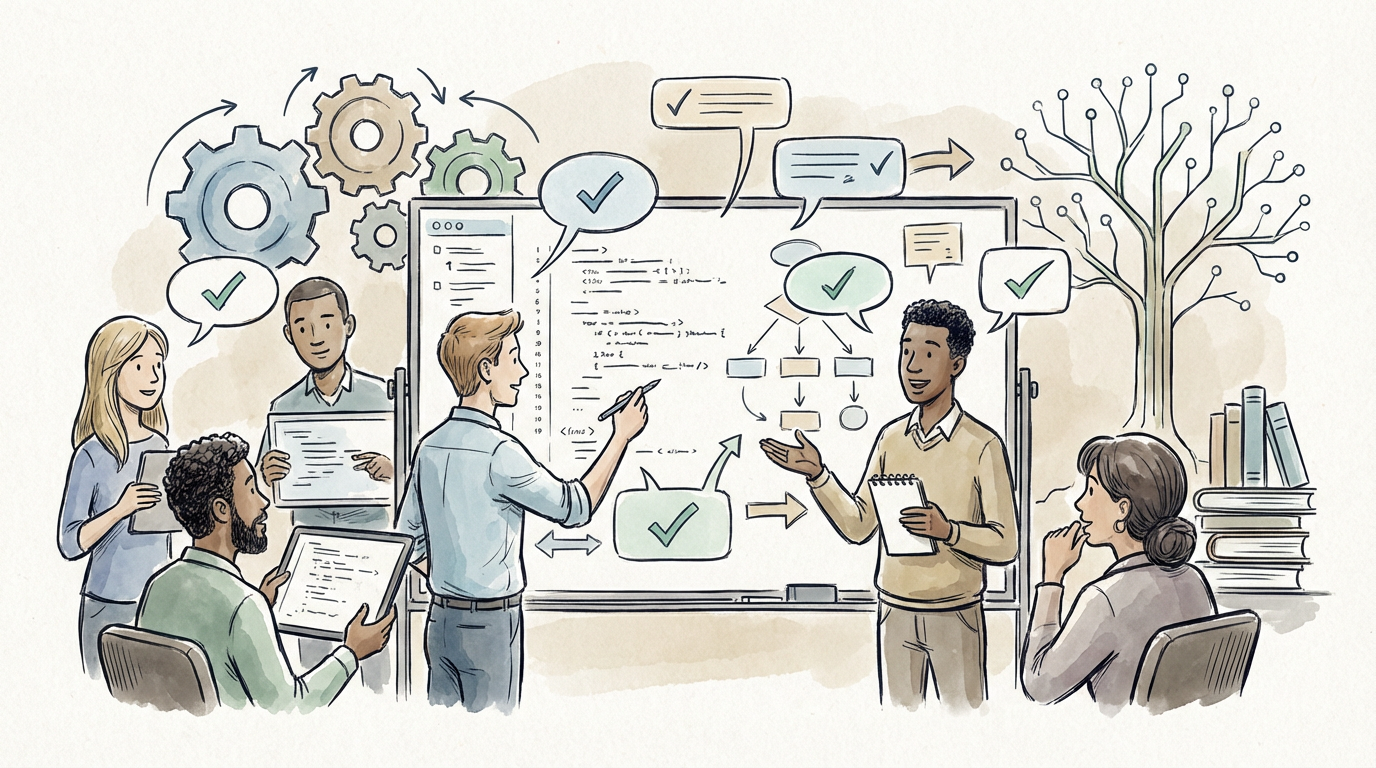
The best code reviews I’ve been part of felt more like collaborative debugging sessions than critique sessions. The reviewer takes time to understand the problem domain, asks clarifying questions, and engages with the solution conceptually before diving into implementation details. They’re looking for logical gaps, unstated assumptions, and edge cases that the author might have missed.
This requires a different mindset than most teams have. Instead of “check for obvious errors,” the goal becomes “help make this code bulletproof.” Reviewers need to allocate real time and mental energy to understanding the change. Authors need to provide context beyond just the diff.
One practice I’ve found invaluable: require authors to include a brief description of their testing strategy in every pull request. Not just “I ran the tests,” but “Here’s how I verified this handles the edge case where the user has no permissions” or “I tested this with a 10MB file to make sure memory usage stays reasonable.” This forces authors to think about verification upfront and gives reviewers concrete scenarios to evaluate.
Building Review Culture, Not Review Theater
The hardest part of fixing code review isn’t technical. It’s cultural. Most teams have trained themselves to treat code review as a checkpoint rather than collaboration. Authors see reviewers as obstacles to deployment. Reviewers see themselves as gatekeepers responsible for catching everything the author missed. This adversarial dynamic breeds resentment and corner-cutting.
Great review culture starts with shared ownership of outcomes. When something breaks in production, the question isn’t “whose fault is this?” but “how do we prevent this category of problem in the future?” This shifts focus from blame to learning and makes people more invested in thorough review.
It also requires psychological safety. Reviewers need to feel comfortable asking “dumb” questions without being dismissed. Authors need to feel comfortable saying “I’m not sure about this part” without looking incompetent. The best technical decisions emerge from honest uncertainty and collaborative problem-solving, not individual heroics.
One concrete practice that helps: rotate review assignments regularly and make sure everyone reviews code above and below their experience level. Junior developers reviewing senior code often spot assumptions that experienced developers take for granted. Senior developers reviewing junior code provide mentorship and catch architectural issues early. Cross-pollination prevents knowledge silos and builds empathy.
The Tooling Trap
Every few months someone discovers a new code review tool that promises to revolutionize the process. AI-powered reviews, automated complexity analysis, sentiment detection for comments. I’ve tried most of them. Here’s what I’ve learned: tooling cannot fix cultural problems.
The best review tools get out of your way. GitHub’s pull request interface isn’t perfect, but it’s good enough that focusing on workflow improvements yields better returns than shopping for alternatives. The real leverage comes from establishing clear expectations, sizing changes appropriately, and creating feedback loops that reinforce good practices.
That said, there are some automation wins worth pursuing. Static analysis tools that catch common security issues, formatters that eliminate style debates, and CI checks that verify tests pass. These all reduce cognitive load on human reviewers. The key is using automation to handle mechanical verification so humans can focus on higher-order concerns like design and correctness.
What’s your experience with code review culture? I’m particularly interested in hearing from teams that have successfully made the transition from review theater to genuine collaboration. Drop your war stories in the comments, both triumphant and cautionary.