Welcome back, tech enthusiasts! Today, let’s talk about something that’s got the creative and tech communities buzzing—Artificial Intelligence in Creative Arts. As an unabashed fan of both tech and creativity, I’m fired up about how AI is transforming our artistic world. This isn’t a dry academic lecture. Think of it as a coffee-infused chat about a future where robots could become the next Picassos or Shakespearean-inspired playwrights.
The Artists of the Ethernet
Let’s face it: when we think of AI, our minds often jump to problem-solving supercomputers or efficient algorithms churning away in the background. But here’s the twist. AI is stepping into the world of creativity—painting, music, storytelling, and beyond.
A Brush with Algorithms
My first encounter with AI art came during a visit to a tech conference, where a digital painting was hanging on display. It wasn’t created by a human but cooked up by the neural network of a machine learning model. And you know what? It was beautiful. It made me question what “art” really means. If a machine can evoke emotions through brush strokes, does it deserve a spot in the Louvre?
AI platforms like DeepArt and Google’s DeepDream have become popular for their ability to morph photos into masterpieces by channeling the style of famous artists. Trust me, people are taking notice. These creative machines are learning from thousands of years of artistic history and pumping out pieces that are mind-bogglingly unique.
The Symphony of Synapses
Shift gears to music, and you’ll find AI composers like AIVA (Artificial Intelligence Virtual Artist) composing symphonies. Initially built as a supporting tool for human composers, AIVA is now crafting entire musical scores for films and games. The little musical earworm stuck in your head after watching a movie might just be courtesy of a neural network.
Just imagine an AI that processes all the works of Mozart and Beethoven, then churns out something both original and familiar. It’s like handing over the baton to an infinite playlist, one that evolves and surprises in delightful ways. Can’t wait for AI-Mozart to drop a new album, right?
The Art of Human-Computer Collaboration
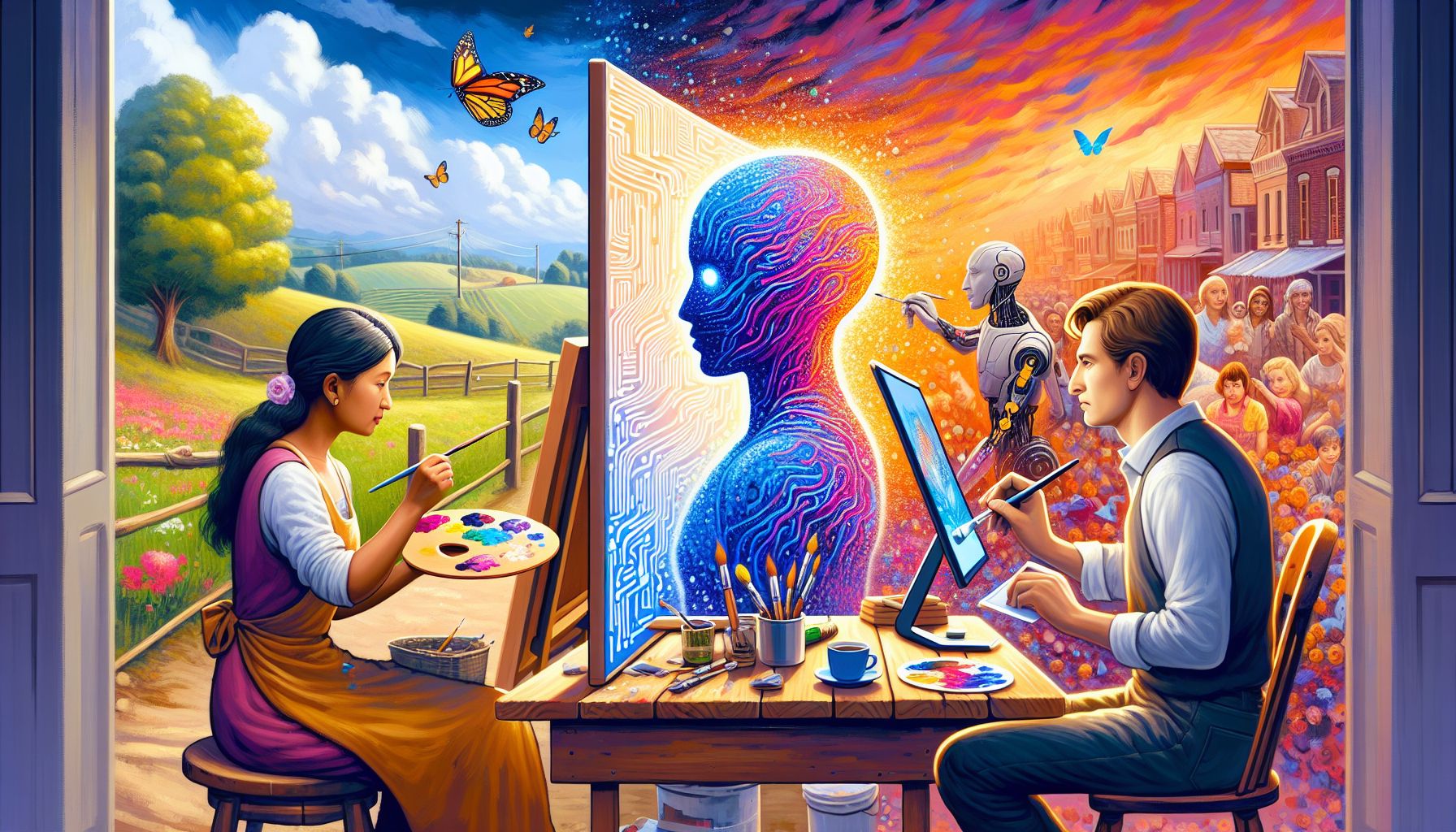
Now, before you get visions of robots eating baguettes on Parisian streets or stealing gigs from starving artists, let’s get real. AI isn’t here to replace us in the creative realms. It’s here to enhance and collaborate.
A Dynamic Duo
Think of AI as our funky new art buddy. IBM’s Watson has teamed up with Grammy-winning producer Alex Da Kid to create music based on emotional responses. Together, they produced chart-topping hits that blend human intuition and AI’s limitless brainpower. It’s a bit like having a trusty sidekick, a Watson to your Sherlock or a Jarvis to your Tony Stark.
Some creatives are using AI to tackle the blank canvas problem. By generating rough drafts of songs, stories, or paintings, AI provides a starting point that artists can work from. The creative control stays fundamentally human.
Not Without Its Challenges
Of course, there are hurdles to jump. Intellectual property rights are a slippery slope in this brave new world. Imagine a painting being compared to the likes of a Van Gogh, yet owned by a machine and technically, its creator. There’s also the matter of taste. AI can mimic but doesn’t have human emotions. An AI-created piece may be technically proficient but lacks the ineffable spark of humanity, at least for now.
Future Tempo: What The Creative World Could Look Like
So, where is all this wild tech creativity going? Honestly, we’re just scratching the surface. Picture this: total creative synergy between AI and humans, leading to unprecedented innovation. From smart clothing that reacts to your body language, to interactive storylines in gaming powered by real-time audience engagement metrics. The possibilities are endless.
Imagine an AI-driven Broadway show that alters its script based on the audience’s reaction, an evening where no two performances are entirely the same. This isn’t just science fiction anymore. It’s on the horizon, and it’s exhilarating.
Conclusion: The Renaissance of AI-Enriched Creativity
Whether you’re a tech whiz, an artist, or somewhere in between, the intersection of AI and the arts is a wild frontier filled with awe and potential. But actualizing this vision means we need to tread carefully, with an eye toward ethics and human emotion. What remains clear is that AI is here to stay in our art studios, music rooms, and design desks.
As someone who enjoys marveling at the changes technology brings, I’m excited to see how this all plays out. In this fast-changing world, the only predictable thing is that the fusion of AI and art will keep us on our toes and keep our imaginations soaring. So, ready your paintbrushes and prepare for a techno-artistic renaissance!
Join me next time as we take on another corner of our fast-paced digital reality. Until then, keep dreaming, keep creating, and let’s make sure that our robotic companions always have a splash of human flair. Cheers!
Related: Earth to Mars: The Dawn of Interplanetary Techno-Utopia